
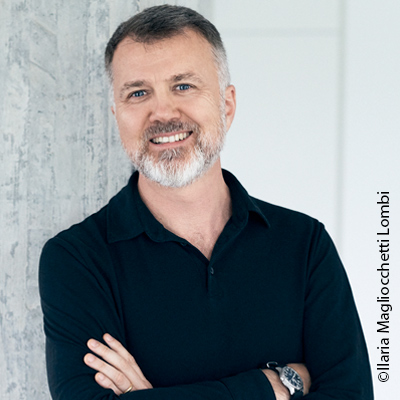
Massimo Alvisi
Massimo Alvisi was born in Barletta in 1967 and graduated in Florence with honors in 1994, with an international thesis in collaboration with the École d’Architecture de La Villette. During university he received a one-year scholarship to Darmstadt, Germany, where he studied environmental sustainability with Thomas Herzog. From 1995 to 2002 he held the role of Design Architect for Renzo Piano Building Workshop, following the project of the Auditorium Parco della Musica in Rome until its completion.
In 2002, together with Junko Kirimoto, he founded the architecture firm Alvisi Kirimoto. The study’s research investigates the relationship between humanity, space, and nature through architecture, urban planning, design, and multimedia art installations, placing a strong emphasis on the cultural and social value of each intervention. Characterized by an empathetic and sensitive approach, at the same time innovative and multidisciplinary, the study develops each project idea starting from manual labor and the manipulation of sheets of paper (The Hands Work), distinguishing itself on the international scene for its attention to urban regeneration and social issues.
He was a technical consultant for Casa Italia and since 2014 he has held the role of tutor of the G124 Project for “the mending of the suburbs”. In 2022, he was a member of the Working Group for the Definition of Guidance and Guidelines for Learning Environments and Teaching, appointed by Education Minister Patrizio Bianchi. Among his various teaching positions were: from 2014 to 2016, he taught the Urban History course at the Faculty of Building Engineering-Architecture at the University of Rome Tor Vergata; from 2018 to 2021, he taught the course “Regeneration Architecture” at the YACademy in Bologna.
Since 2018, he has held seminars, workshops and lectures around the world, including “Working in the Urban Periphery” at the Royal Academy of Arts in London. He participated in several editions of the Venice Architecture Biennale (in 2012, 2016 and 2018) as part of the Scientific Committee supporting the research and contributing to the exhibition itinerary of the Italian Pavilion, arriving in 2025 — at the head of the Habitus Collective — among the finalists for the curation of the Pavilion. In 2019, 2023 and 2025 he participated in the Pisa Architecture Biennale dedicated respectively to the themes of Tempodacqua, The Shared City and Nature.

